

Board Performance · 2025
In this section14 topics
- Prevention of Conflicts of Interest3 items
- Prevention of the Use of Inside Information3 items
- Anti-Corruption4 items
- Whistleblowing3 items
- Selection of Directors & Chief Executives7 items
- Selection of Independent Directors3 items
- Director Development1 item
- Evaluation of Board & Subcommittee Performance3 items
- Subcommittees1 item
- Meeting Attendance & Remuneration3 items
- Supervision of Subsidiaries & Associated Companies4 items
- Board Duty Performance — Overview1 item
- Audit Committee Duty Performance1 item
- Executive Committee Duty Performance1 item
Prevention of Conflicts of Interest
Has the Company Acted to Prevent Conflicts of Interest?
Yes
Operations in the Past Year
The Company monitors, oversees, and manages potential conflicts of interest that may arise between the Company and its management, the Board of Directors, or shareholders, including preventing the improper use of assets, information, and opportunities, as well as inappropriate transactions. A policy has been established requiring directors, executives, and employees to perform their duties for the Company's best interests. In cases where any individual has an interest or is involved in a transaction under consideration, that individual must inform the Company Secretary for the purpose of maintaining conflict of interest reports submitted by directors or executives. This is to be used for auditing and overseeing conflicts of interest.
In the past year, the Company reviewed cases that might involve conflicts of interest. The Audit Committee reviewed connected transactions or transactions that might involve conflicts of interest and opined that the connected transactions were conducted under normal commercial terms, did not involve conflicts of interest, were fair, and had robust and reasonable operating procedures. No unusual transactions were found, and information was disclosed fully and adequately.
The Company has stipulated best practices regarding conflicts of interest in its Corporate Governance Policy and Business Ethics to prioritize the interests of the Company and its stakeholders. Various reports are required to be prepared to prevent conflicts of interest, as follows:
Preparation of reports disclosing potential conflicts of interest or connected transactions
The Company has established policies and procedures for approving transactions that may involve conflicts of interest or connected transactions, strictly adhering to the announcements of the Stock Exchange of Thailand governing connected transactions. This information is also disclosed in the Annual Information Form / Annual Report (One Report).
Preparation of reports on securities holdings and changes in the Company's securities holdings
The Company requires directors, executive directors, and executives (as defined by the Securities and Exchange Commission (SEC) and the Stock Exchange of Thailand), including the number of securities held by related persons under Section 59 of the Securities and Exchange Act of Thailand, to report their holdings of the Company's securities as follows:
-
Initial reporting of securities holdings to the SEC (Form 59-1)
-
Reporting every change in the Company's securities holdings (Form 59-2) when there is a purchase, sale, transfer, or receipt of transfer of the Company's securities, to be submitted within 3 business days from the date of such change.
The Company Secretary is required to report changes in securities holdings to the Board of Directors quarterly, and to maintain records of securities holdings and conflict of interest reports submitted by directors and executives to the Company. The Company has summarized the securities holdings of its directors and executives in the Annual Information Form / Annual Report (One Report).
In 2025, there were changes in the securities holdings of directors and executives as follows:
Shareholdings of the Board of Directors
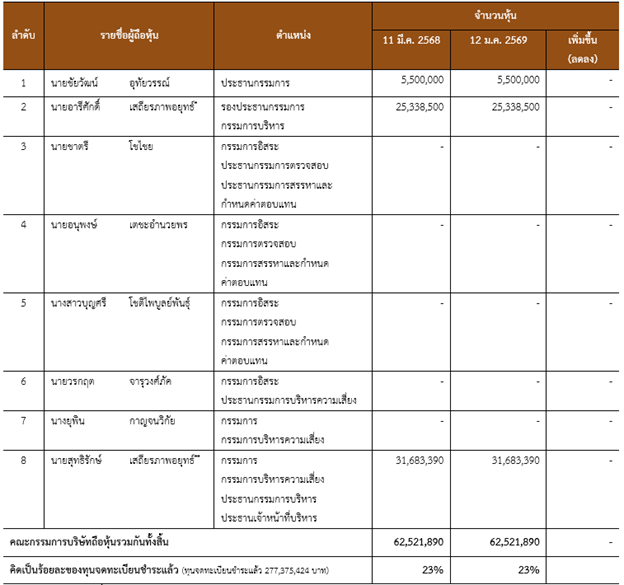
Note :
*Mr. Areesak Sthianraphapoyuth holds a total of 25,338,500 shares with his spouse, comprising his own 14,333,000 shares and his spouse's 11,005,500 shares.
**Mr. Suttirak Sthianraphapoyuth holds a total of 31,683,390 shares with his spouse, comprising his own 20,683,390 shares and his spouse's 11,000,000 shares.
Shareholdings of the Executive Committee
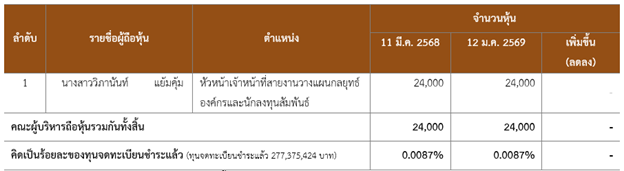
Note: Other executives do not hold shares of the Company, either directly or indirectly.
Preparation of conflict of interest reports for directors, executives, and related persons
The Company requires directors and executives (as defined by the Securities and Exchange Commission (SEC) and the Stock Exchange of Thailand), including the number of securities held by related persons under Section 59 of the Securities and Exchange Act of Thailand, to prepare and submit a conflict of interest report to inform the Company of their own or related persons' interests (including every time there is a change) that are related to the management of the Company or its subsidiaries. The Company Secretary is assigned to summarize the conflict of interest reports (data changes) for acknowledgment by the Board of Directors meeting and to manage the original copies of the conflict of interest reports of directors and executives. Information on the conflicts of interest of directors and executives is also disclosed in the Annual Information Form 56-1 One Report.
Number of Conflict-of-Interest Cases
| Metric | Current Year | Previous Year | Two Years Ago |
|---|---|---|---|
| Total number of cases or issues related to conflicts of interest (cases) | 0 | 0 | 0 |
Prevention of the Use of Inside Information
Has the Company Acted to Prevent the Use of Inside Information?
Yes
Operations in the Past Year
The company has established measures to prevent inappropriate transactions by requiring directors, executives, and employees who may have access to the company's insider information to refrain from trading securities during the period specified by the company. This is to prevent the use of insider information that may affect security prices for the benefit of oneself or others, whether directly or indirectly, and by any means whatsoever. This is in accordance with the guidelines of the Stock Exchange of Thailand and the Securities and Exchange Act, to ensure fairness for all shareholders. Senior executives, including the first four executive positions immediately below the Chief Executive Officer, and those holding positions equivalent to executive-level positions in accounting or finance at the department manager level or higher, or equivalent, must refrain from trading securities at least one month before the announcement of financial statements.
The company has guidelines for considering methods to monitor and control against violations of the insider information usage policy, data security, confidentiality, integrity, and availability of information, which are stipulated in writing and included in the corporate governance and business ethics policy. It is considered the duty of personnel at all levels to meticulously prevent conflicts of interest, adhering to principles of honesty, integrity, rationality, and independence within a sound ethical framework, as well as ensuring full disclosure of information for the company's utmost benefit.
In the past year, the company communicated measures to prevent the use of insider information. This was done via email to all directors, executives, and employees to inform them of the policy and requested them to refrain from buying or selling securities during the period specified by the company. However, no directors or executives of the company were found to have traded securities during the period designated by the company for refraining from trading.
Number of Inside-Information Cases
| Metric | Current Year | Previous Year | Two Years Ago |
|---|---|---|---|
| Total number of cases or issues related to the use of inside information to seek benefits (cases) | 0 | 0 | 0 |
Anti-Corruption
Has the Company Acted on Anti-Corruption?
Yes
Operations in the Past Year
The Board of Directors places importance on participation in anti-corruption efforts and is committed to conducting business with integrity, transparency, and without involvement in corruption. Therefore, the company has established policies and guidelines to prevent corruption in all its business activities, encompassing both internal and external anti-corruption measures. The Audit Committee has been assigned to oversee the internal control system, and management is responsible for raising awareness and communicating the importance of performing duties with integrity to all employees.
In the past year, the company has undertaken the following actions regarding the prevention and anti-corruption efforts:
-
The Audit Committee is responsible for approving the review of internal control systems to prevent corruption risks, such as clearly defining approval authorities based on the scope of duties and responsibilities of each position. The company also has an internal audit unit responsible for reviewing the operations of various departments to ensure that work is performed in accordance with regulations and actual practices, and reports significant issues to the Board of Directors.
-
The Risk Management Committee is responsible for overseeing and monitoring the company's risk management at least once a year, including providing recommendations for risk management to prevent corruption within the company.
-
Dissemination of the Anti-Corruption Policy and the Whistleblowing and Complaint Policy, including channels for whistleblowing or complaints on the company's website.
-
The company conducts a campaign to "decline" gifts and gratuities on all occasions and during all festivals.

Corruption Risk Assessment Process
The company has established a process for assessing corruption risks, with internal auditors conducting the risk assessment. The company has also defined guidelines for various internal control systems to ensure good governance.
Actions taken in cases where corruption is detected
The company will establish a working group to investigate and take disciplinary action. The working group will conduct investigations until a conclusion is reached. Upon reaching a conclusion, the company will impose disciplinary penalties in accordance with the company's regulations and relevant laws, as well as review and examine the company's internal control systems to verify the accuracy of related operational processes and ensure that corrections and improvements are made.
In the past year, the company has implemented anti-corruption measures by integrating them into the orientation training for 100% of all new employees each year. Furthermore, the company has facilitated communication through its Intranet, allowing employees to independently study policies and guidelines at any time. Additionally, the company has communicated important measures regarding giving or receiving gifts during festive seasons to serve as operational guidelines in accordance with the aforementioned policies. The company has not detected any acts leading to corruption.
Form of Anti-Corruption Operations
| Operation |
|---|
| Review of appropriateness in anti-corruption |
| The participation in anti-corruption projects |
| Assessment and identification of corruption risk |
| Communication and training for employees on anti-corruption policy and guidelines |
| The monitoring of the evaluation of compliance with the anti- corruption policy |
| Review of the completeness and adequacy of the process by the Audit Committee or auditor |
Number of Corruption Cases
| Metric | Current Year | Previous Year | Two Years Ago |
|---|---|---|---|
| Total number of cases or issues related to corruption (cases) | 0 | 0 | 0 |
Whistleblowing
Has the Company Implemented Whistleblowing Procedures?
Yes
Operations in the Past Year
Complaint and Whistleblowing Measures
The company has established channels for complaints and whistleblowing, covering the receipt of complaints, fact-finding, and conclusion, as well as the protection of whistleblowers and related individuals. These channels are for receiving complaints, comments, or suggestions from stakeholders who are affected or at risk of being affected by business operations or by the actions of the company's personnel. Such actions must fall under violations or non-compliance with laws, government regulations, corporate governance policies, business ethics, company rules, and regulations, including behavior that may indicate corruption, which refers to any act to seek undue legal benefits for oneself or others, such as embezzlement, corruption, fraud, etc.
The company has published these measures in its Corporate Governance and Business Ethics Handbook, Anti-Corruption Policy, and on its website, to encourage both internal and external stakeholders to participate in the corporate governance process. Therefore, in cases where employees and various stakeholder groups have doubts or observe actions suspected of violating or non-compliance with laws, regulations, rules, ethics, or corporate governance policies.
The company has provided channels for reporting tips or complaints, along with submitting various supporting documents to the company or relevant departments through the contact channels provided by the company. The Audit Committee, which is independent of management, will be responsible for consideration.
Contact the Audit Committee
E-mail address: auditcommittee@thanasiri.com
Mail: Audit Committee
Thanasiri Group Public Company Limited.
No. 650, 652 Borommaratchachonnani Road, Bang Bamru Subdistrict, Bang Phlat District, Bangkok 10700
Complaint Management Process
-
The details of the tip or complaint must be factual, clear, or sufficient to allow for further investigation to ascertain the facts.
-
The duration of the process depends on the complexity of the matter, the sufficiency of documentary evidence received from the complainant, as well as the documentary evidence and explanations from the accused.
-
The recipient of complaints and those involved in the fact-finding process must keep related information confidential and disclose it only as necessary, taking into account the safety and potential harm to the complainant or those cooperating in the fact-finding, the source of information, or related individuals.
-
The person responsible for conducting the investigation will consider the received tips/complaints and proceed with an inquiry to ascertain the facts.
-
Establish measures to cease violations or non-compliance with ethics and mitigate damages for those affected, taking into account the overall distress.
In important cases, the complaint recipient will report the results to the Audit Committee and/or the Board of Directors, such as matters affecting the company's reputation, image, financial status, business operating policies, or matters involving senior executives, etc.
Whistleblower Protection Measures
-
Whistleblowers or complainants may choose not to disclose their name, address, or contact telephone number if they believe such disclosure would lead to unsafety or any harm. However, self-disclosure would facilitate reporting progress, inquiring about additional useful information, clarifying facts, or mitigating damages more conveniently and quickly.
-
The information received will be treated as confidential, and the names of whistleblowers or complainants will not be disclosed to the public without their consent. Whistleblowers or complainants, whether company employees or external individuals, will have their rights protected.
-
In cases where the complainant or those cooperating in the fact-finding believe they may be unsafe or suffer harm, they may request the company to establish appropriate protective measures. Alternatively, the company may implement protective measures without a request from the complainant or those cooperating in the fact-finding, if it deems there is a likelihood of harm or unsafety.
-
Those who suffer distress or damage will receive appropriate and fair compensation through a suitable process.
Protection of rights for employees, workers, or other individuals contracted to work for the company.
The company will not commit any unfair acts against employees, workers, or any other individuals contracted to work for the company, whether by changing job positions, job characteristics, or workplaces, ordering employees, threatening, disrupting work performance, terminating employment, or performing any other act that constitutes unfair treatment towards such individuals due to that individual.
-
Provide information, cooperate, or render assistance in any manner to directors, executives, government agencies, or regulatory bodies, in cases where such individuals have reasonable grounds to believe in good faith that there has been a violation or non-compliance with laws, regulations, rules, ethics, or corporate governance policies.
-
Provide statements, submit documentary evidence, or render assistance in any manner to directors, executives, government agencies, or regulatory bodies for the purpose of considering or investigating cases where there are reasonable grounds to suspect a violation or non-compliance with laws, regulations, ethics, or corporate governance policies.
Penalties
The company has penalties for employees who violate company work regulations and places importance on serious enforcement and punishment. Communication and reinforcement are provided to employees to raise awareness of ethical conduct in operations, and complaints are used for improvement to establish further preventive measures.
In the past year, the company has regularly reported violations of the business ethics and anti-corruption policy to the Corporate Governance and Sustainable Development Committee annually, to monitor compliance with business ethics and to report to the Corporate Governance and Sustainable Development Committee and the Board of Directors for their acknowledgment.
In summary, in the past year, there have been no complaints of corruption, no tips reported, and no violations or non-compliance with laws, regulations, rules, ethics, or corporate governance policies whatsoever.
Number of Whistleblowing Cases
| Metric | Current Year | Previous Year | Two Years Ago |
|---|---|---|---|
| Total number of cases or issues received through whistleblowing channels (cases) | 0 | 0 | 0 |
Selection of Directors & Chief Executives
Selection — Introduction
Regarding the nomination of directors, the Company has a selection process for individuals to be appointed as directors through its Nomination and Remuneration Committee.
In 2025, the Board of Directors supported providing an opportunity for minority shareholders to nominate individuals for selection as company directors. However, no minority shareholders nominated individuals for selection as company directors. Therefore, the Nomination and Remuneration Committee presented its opinion to the Board of Directors regarding the consideration of re-electing the three directors whose terms expire in 2025 for another term. These are: 1) Mr. Chaiwat Uthaiwan, 2) Mr. Areesak Sathianphap-ayuth, and 3) Mr. Anupong Techaamnuayporn.
The Board of Directors has considered the qualifications of the three aforementioned directors in accordance with legal requirements, relevant regulations, and the Company's Board Charter, and has taken into account diversity in the Board's structure, such as skills, knowledge, experience, specialized abilities beneficial to the Company, and the ability to manage the Company's business, without restriction on race, nationality, gender, or age. Furthermore, the Board has considered the performance and dedication of the directors in fulfilling their duties. The Board proposes to the Annual General Meeting of Shareholders 2025 to consider re-electing the three directors whose terms have expired for another term.
For the election of directors at the Shareholders' Meeting, the Company stipulates that shareholders shall have the right to cast votes according to the number of shares they hold, with one share entitling one vote, and shareholders shall cast all their votes for the election of directors on an individual basis.
Directors & Chief Executives — Introduction
The Board of Directors has established a succession plan for senior executives to ensure that the company has transparent criteria and processes for recruiting senior executives and selecting suitable personnel to fill critical management positions at all levels. The details of the senior executive succession plan are as follows:
-
Chief Executive Officer and C-Level
When the position of Chief Executive Officer becomes vacant or the incumbent is unable to perform their duties, the company will have a system for executives at a similar or subordinate level to act as interim until a qualified individual is recruited and selected according to the company's criteria. This individual must possess vision, knowledge, ability, experience, and suitability for the organizational culture, and must be approved by the Nomination and Remuneration Committee for submission to the Board of Directors for consideration and appointment.
-
Senior Executive Level
When an executive position becomes vacant or the incumbent is unable to perform their duties, the company will propose selected successors to the Executive Committee. The company's executive succession planning process is as follows:
2.1 Analyze the company's business situation in terms of corporate strategy, policies, investment plans, and expansion plans.
2.2 Assess workforce readiness in alignment with the company's short-term and long-term strategies.
2.3 Define a workforce readiness plan by developing or recruiting employees to prepare for replacements of departing staff.
2.4 Define competencies, which refer to the desired knowledge, skills, personality, and attitudes of employees in those positions, and create individual development plans.
2.5 Select, evaluate performance, and assess employee potential to determine suitability.
2.6 Develop and evaluate potential successors to ensure they can develop and perform as expected. If expectations are not met, a replacement can be made.
Are Directors Selected Through the Nomination Committee?
Yes
Are Chief Executives Selected Through the Nomination Committee?
Yes
Number of Directors from Major Shareholders
2
Rights of Minority Shareholders on Director Appointment
The Company provides an opportunity for shareholders to nominate qualified individuals for appointment as directors in advance of the Annual General Meeting of Shareholders, between November 1 and December 31 of each year. The Company has disclosed the procedures, methods, and consideration guidelines through its website and has informed shareholders through the channels of the Stock Exchange of Thailand.
In the election of directors, the Company provides an opportunity for shareholders to exercise their right to vote for directors individually. The notice of meeting will include details of the individuals nominated for election as directors, which will be attached and sent to shareholders, including their shareholding proportion in the Company and the number of times they attended Board of Directors' meetings in that year.
Method of Director Appointment
| Method |
|---|
| Method whereby each director requires approval votes more than half of the votes of attending shareholders with voting rights |
Selection of Independent Directors
Introduction
The Nomination and Remuneration Committee will consider and screen suitable individuals for nomination as independent directors, and present their opinions to the Board of Directors and/or the Shareholders' Meeting for further consideration and approval of such appointments. In addition, the Nomination and Remuneration Committee has supported providing opportunities for minority shareholders to nominate individuals for selection as company directors, including considering the use of a Director Pool database to assist in the consideration of new director nominations. This is in accordance with relevant policies and charters, the Company's Articles of Association, and applicable legal requirements. To protect the rights of minority shareholders, the Company will arrange for a vote on the appointment of directors individually during the agenda item for director appointments at the Company's Shareholders' Meeting.
Criteria for Selecting Independent Directors
Qualifications of Independent Directors
The company defines the term "Independent Director" as a director who does not perform management duties for the company and/or its subsidiaries, is independent from management and controlling shareholders, and has no business relationship with the company that would restrict their ability to express independent opinions, and possesses the following qualifications:
-
Independent directors must possess all qualifications as prescribed by the company, equivalent to and in compliance with good corporate governance principles and practices of the Securities and Exchange Commission, and the regulations of the Stock Exchange of Thailand, to build investor confidence and maintain a balance of good management.
-
A person holding not more than 1 percent of the total voting shares of the company and/or its subsidiaries, including shares held by related parties.
-
Not involved in management, not an employee, staff, salaried advisor, or not a professional service provider such as an auditor, lawyer, or other profession that restricts the ability to express independent opinions to the company, its subsidiaries, or associated companies, or not a person with controlling power over the company, its subsidiaries, or associated companies, or not a person who may have a conflict of interest, and must have ceased such status or position that may cause such conflict for at least 2 years.
-
No business relationship that restricts the independence in performing duties as a director, as per the regulations of the Securities and Exchange Commission, and no direct or indirect benefits or interests in the financial management or operations of the company, its subsidiaries, associated companies, or major shareholders of the company.
-
No blood relationship or registered relationship as father-mother, spouse, siblings, and children, including spouses and children of executives or major shareholders, controlling persons, or individuals to be nominated as executives or controlling persons of the company and its subsidiaries.
-
Not appointed as a representative to protect the interests of the company's directors, major shareholders, or shareholders related to the company's major shareholders.
-
Able to perform duties and express opinions or report on the performance of duties assigned by the Board of Directors independently, without being under the control of the company's executives or major shareholders, including related parties or close relatives of such persons.
Independent Director Selection Process
The company has a process for selecting independent directors that is identical to the process for selecting directors.
Did Any Independent Director Have a Business or Professional Relationship?
No
Director Development
Director Development — Introduction
The company supports participation in various training courses or seminars to enhance the knowledge of its board of directors, executives, and employees. It has a policy to encourage directors and executives to attend various seminars and training courses, such as those organized by the Thai Institute of Directors Association, the Stock Exchange of Thailand, the Securities and Exchange Commission (SEC), and related agencies or other institutions. This includes development pertaining to the responsibilities of directors or evolving management approaches, to ensure that all directors continuously develop and improve their performance.
Evaluation of Board & Subcommittee Performance
Evaluation — Introduction
The company conducts an annual performance evaluation of the Board of Directors to serve as a framework for the Board of Directors' performance of duties in accordance with good corporate governance principles and to utilize the evaluation results to improve the Board of Directors' performance of duties.
The Board of Directors mandates self-assessment (Board Self-Assessment) on both a collective and individual basis. The current Board performance evaluation form used by the company for assessment refers to the Board performance evaluation form from the Thai Institute of Directors (IOD) of the Stock Exchange of Thailand as a guideline for evaluation, in order to ensure compliance with good corporate governance principles.
Criteria for Evaluating Board Performance
The company uses a Board performance evaluation form, referencing the self-assessment form for the Board of Directors prepared by the Capital Market Governance Development Department, Stock Exchange of Thailand in 2015, as a guideline for evaluation.
Self-assessment form for the Board of Directors as a whole Comprises 4 topics for consideration as follows: 1) Board structure and qualifications, 2) Board meetings, 3) Roles, duties, and responsibilities of the Board, and 4) Relationship with management and self-development of directors.
Self-assessment form for individual directors Comprises 3 topics for consideration as follows: 1) Board structure and qualifications, 2) Board meetings, and 3) Roles, duties, and responsibilities of the Board.
Scoring is done by each director indicating their opinion by marking ( / ) in only one score box from 1-5 on the assessment form, with the following meanings:
1 = Strongly disagree or no action has been taken on the matter
2 = Disagree or minimal action has been taken on the matter
3 = Agree or moderate action has been taken on the matter
4 = Agree considerably or good action has been taken on the matter
5 = Strongly agree or excellent action has been taken on the matter
Subsequently, all obtained scores are processed by calculating the percentage of the full score, which is set as criteria as follows:
Equal to or greater than 85 = Excellent
Equal to or greater than 75-84 = Very Good
Equal to or greater than 65-74 = Good
Equal to or greater than 50-64 = Satisfactory
Below 50 = Needs improvement
Evaluation of Board Performance in the Past Year
For the year 2025, the performance evaluation results of the Board of Directors, both as a whole and individually, are summarized as follows: The total number of directors on the Board is appropriate for the nature of the company's business. The Board of Directors comprises individuals with knowledge, competence, experience, and understanding of the business, with at least one-third of the total number of directors being non-executive directors. Additionally, sub-committees have been established to support the work of the Board of Directors, namely the Audit Committee, the Nomination and Remuneration Committee, the Risk Management Committee, the Corporate Governance and Organizational Sustainability Development Committee, and the Executive Committee, with clearly defined duties and responsibilities. The Board of Directors has given importance and allocated sufficient time to perform its duties appropriately.
The Board of Directors participates in defining the vision, mission, strategies, and goals, as well as regularly overseeing and monitoring operational performance. The levels of operational authority and financial approval processes are clearly defined. Directors also prioritize the accuracy of financial reports, information disclosure, and ensuring fairness by preventing conflicts of interest, with clearly defined approval and operational procedures. Furthermore, interested directors shall not have the right to vote on such connected transactions. In addition, the Board of Directors maintains good relations with management and does not interfere with management's duties.
The Board of Directors oversees that the company has internal control and risk management systems that are sufficient and appropriate for the nature of the company's business, and continuously supports compliance with the regulations of the Stock Exchange of Thailand and the Securities and Exchange Commission, the corporate governance policy, and the company's business ethics handbook.
The performance evaluation results of the Board of Directors, both as a whole and individually, are rated as excellent.
Subcommittees
Subcommittees
| Results of the Subcommittee's Duty Performance | Meetings — Introduction |
|---|---|
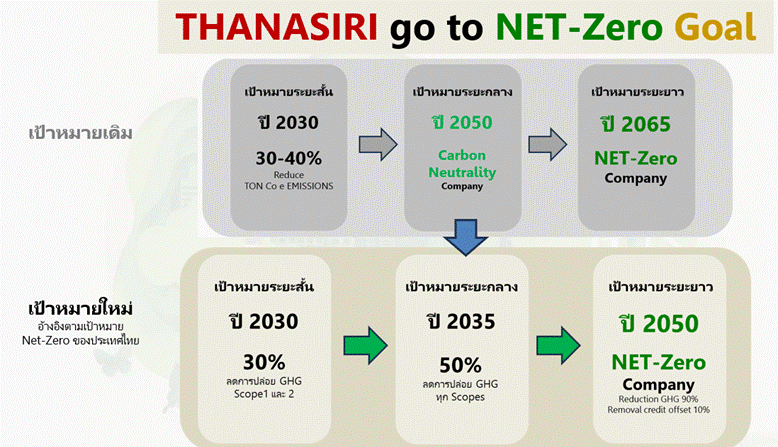
The company is committed to continuously implementing sustainability initiatives to ensure that all stakeholders understand and can apply the THANA Green process in their work lives. | The Corporate Governance and Sustainable Development Committee of Thanasi Group Public Company Limited was appointed by the Board of Directors, comprising 6 company directors and senior executives who possess knowledge beneficial to good corporate governance and the sustainable development of the company. The Corporate Governance and Sustainable Development Committee has complied with the scope of duties and responsibilities stipulated in its charter, in accordance with the company's corporate governance policy and business ethics, and reports to the Board of Directors, providing opinions on practices and recommendations for appropriate revision and improvement. |
The Nomination and Remuneration Committee has performed its assigned duties with prudence, thoroughness, transparency, and reasonableness, prioritizing the best interests of the Company and its shareholders, in accordance with the scope of duties and responsibilities defined in the Nomination and Remuneration Committee Charter, and has reported to the Board of Directors. Performance in Nomination At the Annual General Meeting of Shareholders for the year 2025, the Company has three directors whose terms are expiring out of a total of nine directors: 1. Mr. Chaiwat Uthaiwan, Chairman of the Board; 2. Mr. Areesak Sathianphap-ayuth, Vice Chairman and Executive Director; and 3. Mr. Anupong Techamnuayporn, Audit Committee Member, Nomination and Remuneration Committee Member, and Independent Director. The Nomination and Remuneration Committee has conducted the director nomination process by considering individuals with knowledge, abilities, experience, and a good work history, possessing leadership qualities, broad vision, as well as integrity, ethics, and a positive attitude towards the organization, capable of dedicating sufficient time, which is beneficial and suitable for the Company's operations. The Committee also considered the independence of independent directors regarding their efficiency in performing duties, ensuring they can provide opinions independently and in accordance with relevant criteria through a transparent process to build confidence among shareholders. The Company provided an opportunity for minority shareholders to propose names of individuals for directorships in advance, 60 days before the end of the accounting period (November 1 – December 31, 2024), via the Company's website, and the Company also disseminated this information through the news system of the Stock Exchange of Thailand. It appears that in 2025, No shareholder proposed List of suitable individuals for election to serve as directors of the company The Nomination and Remuneration Committee, excluding interested directors, has therefore considered the qualifications of the three directors whose terms are expiring, in various aspects, assessing their suitability in terms of qualifications, knowledge, abilities, experience beneficial to the Company's business operations, and their performance as Company directors during the past year. This also includes ensuring they fully meet the qualifications under the Public Limited Company Act B.E. 2535 (1992) and do not possess any prohibited characteristics for appointment as a Company director according to the criteria of the Securities and Exchange Commission and relevant government agencies. It is proposed that the Board of Directors consider submitting this to the Annual General Meeting of Shareholders to re-elect the directors whose terms have expired for another term. The Board of Directors, excluding interested directors, has considered the nominations proposed by the Nomination and Remuneration Committee, in accordance with the nomination process established by the Company's Board of Directors. The individuals nominated have passed the Company's prescribed review process and possess qualifications that comply with relevant regulations and are suitable for the Company's business operations. After a thorough and careful individual screening of the qualifications of the nominated directors, the Board of Directors is of the opinion that the individuals nominated as directors have undergone a meticulous and careful screening and review process by the Board of Directors and are deemed to possess qualifications suitable for the Company's business operations. It is therefore proposed to the Annual General Meeting of Shareholders for the year 2025 to consider re-electing all three directors for another term, and that the directors approved by the shareholders shall resume their positions on various sub-committees as before. Performance in Remuneration Consideration In 2025, regarding the consideration of directors' remuneration, the Company's Board of Directors assigned the Nomination and Remuneration Committee to consider and determine the remuneration, with the following guidelines for consideration:
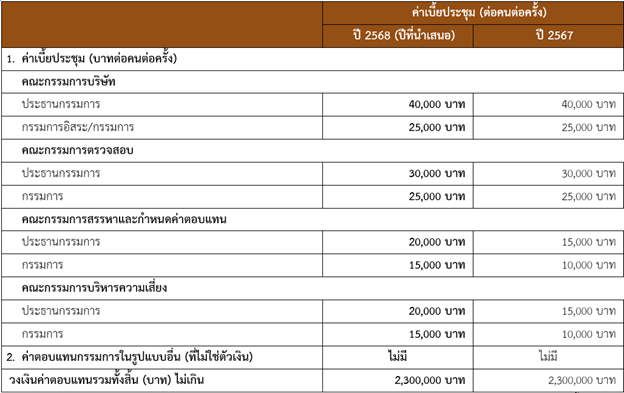
Therefore, in 2025, the Nomination and Remuneration Committee considered the directors' remuneration in accordance with the Company's policy and criteria for director remuneration, and by comparing it with other companies in the same industry with similar business size and characteristics, the Company's business expansion and profit growth, as well as considering the responsibilities and performance of the Board of Directors and sub-committees. It is deemed appropriate to set the remuneration for the Board of Directors and sub-committees for the year 2025 with a total budget not exceeding 2,300,000 Baht (Two Million Three Hundred Thousand Baht only), which constitutes directors' remuneration comprising meeting allowances, gratuities, and bonuses (without other benefits), with details as follows:
Note: The Executive Committee and the Corporate Governance and Sustainable Development Committee receive remuneration in the form of a salary instead of meeting allowances. Consideration of Other Matters In performing the duties of the Nomination and Remuneration Committee throughout 2025, all directors emphasized participation in meetings, presentation of opinions, thorough preparation, and comprehensive study of relevant information with prudence. They promoted independent and constructive expression of opinions from each director to establish standards and define clear, transparent, and fair practices in line with good corporate governance principles, for the long-term sustainable benefit of the organization. | The Nomination and Remuneration Committee has performed its duties assigned by the Board of Directors with dedication, prudence, caution, and reasonableness, in order to uphold the company's good corporate governance policy and the good corporate governance principles of the Stock Exchange of Thailand, particularly in matters related to the nomination and consideration of remuneration for directors in various positions, ensuring appropriateness, fairness to stakeholders, and efficiency for the business. The Nomination and Remuneration Committee comprises 3 independent directors. In 2025, a total of 1 meeting was held. Each director participated according to their roles and responsibilities. All directors prioritized attending scheduled meetings to their full potential and reviewed various matters in line with their duties, including openly expressing their opinions. The Committee then prepared its recommendations for submission to the Board of Directors for consideration. A summary of the key operational aspects is as follows: |
The Risk Management Committee is committed to performing its duties to the best of its ability for the maximum benefit and equality of all shareholders and stakeholders, to lead the organization towards stable and sustainable growth. | The Risk Management Committee has performed its duties as assigned by the Board of Directors to ensure operations adhere to the principles of good corporate governance and checks and balances. This includes monitoring risk issues, identifying preventive measures, and managing risks at an appropriate level, effectively and efficiently in line with prevailing circumstances, without adversely impacting the company's operations. Consequently, it is deemed appropriate for the company to establish a Risk Management Committee, a mandate received from the Board of Directors. The Risk Management Committee consists of at least 3 directors and/or senior executives (from chief officers upwards). In 2025, a total of 2 meetings were held. The key operational highlights are summarized as follows: |
Meeting Attendance & Remuneration
Justification for Directors' Non-Attendance
Mr. Charan Ketsorn attended 3 out of 6 board meetings. This was because, in early August 2025, Mr. Charan Ketsorn submitted a letter of resignation from his position as a director due to other commitments.
Types of Remuneration of the Board of Directors
The Company sets the remuneration for the Board of Directors at an appropriate rate by comparing it with the remuneration standards of other companies in the same business. The directors' remuneration consists of director's fees, meeting allowances, and a bonus, which is a special remuneration considered based on the Company's profits. There are no other forms of remuneration. The Nomination and Remuneration Committee is responsible for initially considering and determining the remuneration to propose it to the Board of Directors for approval before presenting it to the Shareholders' Meeting for annual approval.
The Annual General Meeting of Shareholders for 2025, held on April 11, 2025, resolved to approve the remuneration for directors and sub-committee members for the year 2025. The total remuneration budget shall not exceed 2,300,000 Baht (Two Million Three Hundred Thousand Baht only). The Board of Directors or its authorized delegate is empowered to allocate the said amount to individual directors and sub-committee members as deemed appropriate. Monetary remuneration for directors consists of meeting allowances, which are paid based on the number of meetings attended, and there are no other forms of remuneration.
Remuneration or Benefits Payable to the Board
| Metric | Amount (Baht) |
|---|---|
| Remunerations or benefits pending payment to the board of directors over the past year (baht) | 0 |
Supervision of Subsidiaries & Associated Companies
Does the Company Have Subsidiaries or Associated Companies?
Yes
Is There a Mechanism for Overseeing Subsidiaries and Associated Companies?
Yes
Mechanism for Overseeing Management of Subsidiaries
The Board of Directors has mechanisms to oversee the operations of subsidiaries and associates to protect the company's investment interests as follows:
-
Individuals are appointed to represent the company as directors, executives, or controlling persons in such companies in proportion to the shareholding, subject to the approval of the Board of Directors meeting.
-
The scope of duties and responsibilities of directors and executives representing the company in such companies is defined for controlling or participating in the formulation of policies critical to business operations.
-
The company oversees the complete and accurate disclosure of financial status and operating results, transactions between such companies and related parties, the acquisition or disposal of assets, or any other significant transactions of such companies, using the same criteria as those of the company, through the accounting and finance department and the company's internal audit unit.
-
Appropriate, stringent, and sufficient internal control systems are established in subsidiaries and audited by the company's internal audit unit.
Oversight Mechanisms
| Mechanism |
|---|
| Sending representatives to act as directors, executives or controlling persons in proportion to shareholdings |
| Defining the scope of powers, duties and responsibilities of directors and executives who represent the company in setting important policies |
| Disclosure of financial information and operating results |
| Transactions between the Company and related persons |
| Other important transactions |
| Acquisition or disposal of assets |
| Internal control system of the subsidiary operating the core business is appropriate and sufficient in the subsidiary operating the core business |
Board Duty Performance — Overview
Board Duty Performance — Overall Description
Over the past year, the Board of Directors has prioritized good corporate governance and sustainable development, which are crucial management approaches in the face of business challenges. Consequently, the Board plays a role in establishing policies and practices for good corporate governance, as well as defining business policies, strategies, and goals, including operational frameworks and procedures to foster sustainable business growth. This is achieved by adhering to all 8 principles of the Corporate Governance Code for Listed Companies 2017 (CG Code), based on the "Apply or Explain" principle, to create sustainable value for the organization and to ensure that practices are sufficiently appropriate for adaptation to changing factors. This aligns with creating value for the organization, customers, stakeholders, and society as a whole. The vision, strategies, goals, and action plans are reviewed annually, taking into account the company's environmental factors at each period, including both short-term and long-term goal setting. Oversight is provided to ensure appropriate resource allocation and operational control.
Audit Committee Duty Performance
Results of the Audit Committee's Duty Performance in the Past Year
The Audit Committee has performed its duties within the scope and responsibilities of the mission assigned by the Board of Directors in overseeing the company's operations to ensure that the executive directors and management have fully managed the company's affairs in accordance with the company's policies, complying with the regulations and guidelines of the Stock Exchange of Thailand, as well as good corporate governance principles, the key aspects of which are summarized as follows:
Review of financial statements for the year 2025 : The Audit Committee has reviewed the company's quarterly financial statements and consolidated financial statements, as well as the annual financial statements for 2025, in conjunction with management and the auditors. Management is responsible for preparing the financial reports, while the auditors are responsible for reporting and expressing an opinion on these financial statements. The Audit Committee is of the opinion that the company's financial reports have been prepared correctly in accordance with generally accepted accounting principles and include sufficient disclosure of significant information in the notes to the financial statements.
Review of internal control system and internal audit : The Audit Committee has reviewed the internal control system, including operational oversight, anti-corruption measures, and the establishment of preventive guidelines for potential corruption. This includes providing channels for complaints and whistleblowing (regarding corruption, misconduct, or breaches of business ethics) via the company's website and email, as well as implementing appropriate procedures for handling complaints and protecting whistleblowers. In 2025, the company appointed Mr. Apakorn Thetphan from Professional Audit Co., Ltd. to serve as the company's internal auditor, to audit operations, provide recommendations, follow up on the implementation of recommendations, and report the results of the internal control system audit to the Audit Committee.
The results of the internal audit did not reveal any significant weaknesses or deficiencies in the internal control system regarding anti-corruption measures. The Audit Committee is of the opinion that the company has adequate and appropriate internal control systems and oversight of compliance with anti-corruption measures.
Review of compliance with business-related laws : The Audit Committee has reviewed the company's compliance with securities and exchange laws, regulations of the Stock Exchange of Thailand and the Securities and Exchange Commission, and other laws related to the company's business. No reports from external auditors, complaints from third parties, disclosures by management, or findings from internal auditors indicated non-compliance with laws. This provides assurance that the company has no significant non-compliance with laws that would materially affect the company.
Consideration of the proposal for the appointment of auditors and audit fees for the year 2025 : The Audit Committee considered selecting and proposing the appointment of Ms. Nammon Kerdmongkolchai, Certified Public Accountant No. 8368, and/or Ms. Kedsiri Kanchanaprakasit, Certified Public Accountant No. 6014, and/or Ms. Pimjai Manitkajornkij, Certified Public Accountant No. 4521, and/or Ms. Kingkarn Asawarungsarit, Certified Public Accountant No. 4496, from EY Office Limited, as the auditors of the company and its subsidiaries for the fiscal year ending December 31, 2025. Any one of the auditors shall have the authority to audit and express an opinion on the company's financial statements, including the consolidated financial statements. In the event that any of the aforementioned auditors are unable to perform their duties, EY Office Limited shall have the authority to appoint another certified public accountant from EY Office Limited to act as a substitute. The audit fee for the year 2025 is set at a total of 1,700,000 Baht (One Million Seven Hundred Thousand Baht). All auditors have no relationship and/or conflict of interest with the company, its subsidiaries, management, or major shareholders whatsoever. Therefore, the Audit Committee proposed to the Board of Directors for consideration to present to the Annual General Meeting of Shareholders for approval at the Annual General Meeting held on April 11, 2025.
Review of related party transactions or transactions that may have conflicts of interest : The Audit Committee has reviewed related party transactions or transactions that may have conflicts of interest of the company and its subsidiaries in accordance with the criteria of the Stock Exchange of Thailand. The Audit Committee is of the opinion that such transactions were reasonable, conducted under normal business conditions, and for the utmost benefit of the company. Furthermore, intercompany transactions between the company and its group companies, as well as related party transactions, were disclosed accurately, completely, and sufficiently.
Review of the Audit Committee's charter : The Audit Committee has invited management to attend meetings for continuous discussion and knowledge exchange, to stay informed about changes in various rules, regulations, and requirements related to the company's operations, ensuring that duties are performed efficiently and are responsive to potential changes. Additionally, the Audit Committee prepares meeting reports for submission to the Board of Directors after each meeting, in line with good practices for audit committees.
Additionally, the Audit Committee has reviewed its charter to ensure its appropriateness and alignment with the Audit Committee's duties and responsibilities, as well as relevant laws. The Audit Committee has performed its duties with prudence, independence, and transparency for the utmost benefit of the company.
From performing its duties within the scope and responsibilities assigned by the Board of Directors with prudence and independence, the Audit Committee is of the opinion that the company operates under an effective internal control system, with adequate and appropriate risk management for the company's business operations. No significant items or situations related to the internal control system were found to be material weaknesses that could affect the company's financial position and operating results. The company's financial statements adequately disclose related party transactions and transactions that may have conflicts of interest. Furthermore, the company complies with laws, regulations, and requirements related to its business operations, and its operations are sufficiently aligned with good corporate governance principles, being transparent and reliable. The company also continuously develops and improves its operational systems to enhance quality and suit the business environment.
Executive Committee Duty Performance
Results of the Executive Committee's Duty Performance in the Past Year
The Executive Committee has performed its duties within the scope and responsibilities of the tasks assigned by the Board of Directors in overseeing the company's operations with diligence, prudence, transparency, and reasonableness, prioritizing the best interests of the company and its shareholders, to ensure that the company's operations comply with the budget and business plan approved by the Board of Directors, as follows:
Consider planning and defining operational strategies in conjunction with the senior management team across all business units of the company.
Consider and approve the company's business plan and annual budget for submission to the Board of Directors.
Consider and monitor the performance of the company, its subsidiaries, and associated companies regularly, at least twice a month.
Execute various matters as assigned by the Board of Directors.
The Executive Committee is committed to performing its duties to the best of its ability for the maximum benefit and equality of all shareholders and stakeholders, in order to lead the organization towards stable and sustainable growth.