

CG Policy · 2025
In this section7 topics
Corporate Governance Policy
Introduction
The Board of Directors and management are committed to and recognize the importance of good corporate governance to ensure the organization's sustainable growth under the principles of good governance. This involves conducting business responsibly towards all stakeholder groups, building trust and good relationships with all parties, and enhancing the Board's understanding of the business context, stakeholder expectations, opportunities, and risks that impact the organization's operations in accordance with good governance principles, with transparency, integrity, fairness, and accountability, under "Corporate Governance Policy and Business Ethics"
Has a Corporate Governance Policy
Yes
Policy Description
Corporate Governance Policy and Practices are formulated with consideration for the Principles of Good Corporate Governance for Listed Companies 2017 of the Securities and Exchange Commission (SEC) and assessments from various external agencies such as the Stock Exchange of Thailand (SET), and recommendations from the Corporate Governance Assessment Report of the Thai Institute of Directors (IOD), which are reflected in the Corporate Governance Policy and Business Ethics.
The Corporate Governance Policy and Practices encompass the nomination and remuneration of directors and executives, the independence of management, director development and performance evaluation of the Board of Directors, as well as the supervision of subsidiaries and associated companies, responsibility towards shareholders and stakeholders, the prevention of insider trading, and the prevention of conflicts of interest.
Policy & Practices — Board of Directors
Has Policy & Guidelines for the Board
Yes
Board Guidelines
| Guideline | Other — Please Specify | Detail |
|---|---|---|
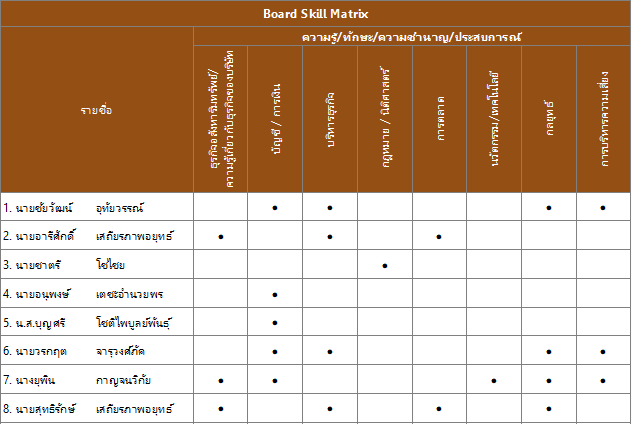
| Nomination of Directors | The Nomination and Remuneration Committee is responsible for approving the policies and criteria for director nomination, defining the qualifications of individuals to serve as directors, taking into account diversity in knowledge, expertise, skills, and beneficial experience, consistent with the Company's business strategies (Board Skill Matrix), without limitation to gender, race, nationality, country of origin, culture, religion, age, or any other specific characteristics. Directors must be able to fully dedicate their time to performing their duties and must not possess any prohibited characteristics under the law and good corporate governance principles. The Board of Directors will oversee that the nomination and selection process for directors is transparent and clear, to ensure that the Board comprises individuals with qualifications consistent with the prescribed composition, before presenting them to the shareholders' meeting for appointment as directors of the Company. In the event of a vacancy on the Board of Directors, the Nomination and Remuneration Committee shall consider and screen suitable individuals for nomination as directors and present their recommendations to the Board of Directors and/or the shareholders' meeting for approval of such appointments. Furthermore, the Nomination and Remuneration Committee supports providing opportunities for minority shareholders to nominate individuals for selection as directors, including considering the use of a Director Pool database to assist in the selection of new directors. This is in accordance with relevant policies and charters, the Company's Articles of Association, and applicable legal requirements. To protect the rights of minority shareholders, the Company will arrange for individual voting on the appointment of directors during the agenda item for director appointments at the Company's shareholders' meeting. Qualifications of Directors
Qualifications of Independent Directors The Company defines "Independent Director" as a director who does not perform management duties for the company and/or its subsidiaries, is independent from management and controlling shareholders, and has no business relationship with the company that would restrict their ability to express independent opinions, and possesses the following qualifications:
Appointment and Removal of Directors
Term of Office The term of office for directors of the Company is 2 years per term, and they may be re-appointed by shareholders for another term. Board Structure
Director Nomination Process The Nomination and Remuneration Committee shall consider and select individuals based on their knowledge, abilities, expertise, and experience, a good work history, broad vision, as well as ethics and morality. They must be able to dedicate sufficient time to the company and diligently perform their duties and responsibilities, which will benefit the company's operations in achieving its goals and objectives. Furthermore, independence and Board Diversity policy are considered, and a Skill Matrix has been developed to define the qualifications of desired directors, based on essential missing skills, as well as suitable qualifications consistent with the composition and structure of the Board according to the Company's business strategic plan, without limitation to gender, age, race, nationality, religion, or any other differences. It is believed that diversity promotes multiple perspectives, which is a crucial component supporting the Company in achieving its set objectives and sustainable growth. The Board of Directors shall possess suitable qualifications consistent with the Company's business strategies, as well as diversity in knowledge, abilities, skills, experience, and expertise beneficial to the Company's operations, as follows:
The Company has provided an opportunity for shareholders to nominate individuals for consideration as directors at the shareholders' meeting in advance, by announcing the criteria for consideration on the Company's website from November 1st to December 31st of every year. The Nomination and Remuneration Committee will consider and select suitable individuals who meet the qualifications for directors set by the Company, and propose them to the Board of Directors for approval, to then be presented to the shareholders' meeting for approval of the election of directors according to the established criteria. In this regard, the Board of Directors will ensure that the notice of the shareholders' meeting contains sufficient information about the nominated individuals to aid decision-making, including their full name, background, type of directorship proposed, number of terms/years the existing director has served, shareholding in the company, number of attendances at Board/sub-committee meetings in the past year, whether they hold directorships/executive positions in other entities that are in business competition with the company, etc. For the Annual General Meeting of Shareholders, regarding the agenda item for the election of the Company's directors, in adherence to good corporate governance principles, the Company will adopt a method of electing directors individually. This requires approval by a majority vote of the shareholders present and entitled to vote, with each shareholder having votes equal to the number of shares they hold. | |
| Determination of Director Remuneration | The Board of Directors has assigned the Nomination and Remuneration Committee to propose criteria and guidelines for appropriate remuneration for the Board of Directors and sub-committee members, taking into account appropriateness, fairness, clarity, transparency, and sufficiency. This is achieved by using comparative references from the same industry, considering experience, scope of duties, and assigned responsibilities, as well as the company's business expansion and profit growth, to reflect the directors' performance and to incentivize them to consistently perform their duties by attending meetings. The Nomination and Remuneration Committee shall propose the remuneration rates for the company's directors and sub-committee members to the Board of Directors for consideration and approval, and subsequently submit them to the Shareholders' Meeting for final approval. The guidelines for remuneration consideration are as follows:
| |
| Independence of the Board of Directors from the Management | Separation of the positions of Chairman of the Board and Chief Executive Officer The company promotes good corporate governance. The Board of Directors stipulates that the Chairman of the Board must not be the same person as the Chief Executive Officer, and clearly defines the segregation of duties and responsibilities. All approvals and operations are in accordance with the scope of authority approved by the Board of Directors. This is to enable the Board of Directors to independently monitor and balance the management's operations. Checks and balances of directors The company ensures an appropriate composition of the Board of Directors and clearly segregates the roles, duties, and responsibilities between the Board of Directors and management. All directors are independent in expressing their opinions on the company's operations with honesty and integrity, safeguarding the interests of the company and various stakeholders without being unduly influenced. Furthermore, they are responsible for performing their duties in accordance with laws, the company's articles of association, resolutions of the Board of Directors' meetings, and resolutions of shareholders' meetings. Holding directorships in other companies by the Chief Executive Officer The company has established policies and procedures for the Chief Executive Officer to hold any position in other companies, in order to comply with good corporate governance principles. The Chief Executive Officer is responsible for reporting and disclosing information regarding the company name, business type, and position held for the Board of Directors' approval, in addition to reporting conflicts of interest upon assuming the position. This is to ensure that the Chief Executive Officer can fully dedicate time to performing duties within the company and achieve maximum efficiency in the company's management. | |
| Director Development | The Board of Directors has promoted and facilitated various training courses or seminars beneficial to the performance of directors' duties, organized by the Thai Institute of Directors Association, the Stock Exchange of Thailand, the SEC Office, or other independent organizations, and providing knowledge to those involved in the company's corporate governance, such as directors, sub-committee members, and executives, to enhance knowledge, improve performance, and contribute to more efficient duty execution. It is stipulated that at least one director must attend various training courses or seminars annually to enhance their operational knowledge. Furthermore, to enhance the efficiency and effectiveness of their performance as directors, the Company has a policy to promote and support all directors in attending training and knowledge development programs with the Thai Institute of Directors Association (IOD) and other institutions in courses relevant to directors. This is to build confidence among shareholders and general investors that the directors possess the knowledge and understanding required to perform their duties in accordance with good corporate governance principles. Coordination is maintained for directors to consider continuous training throughout the year. | |
| Board Performance Evaluation | In accordance with good corporate governance principles, the Board of Directors has stipulated that the performance of the Board of Directors and sub-committees shall be evaluated at least once a year. This includes the performance evaluation of the Board of Directors as a whole and on an individual basis (self-assessment), and the performance evaluation of all sub-committees. The processes and criteria for evaluating the performance of the Board of Directors and sub-committees have been established. This is to review the performance of the duties of the Board of Directors and sub-committees, as well as to consider and review the compilation of comments on various issues related to the performance of duties during the past year, in order to make corrections and further enhance work efficiency. | |
| Corporate Governance of Subsidiaries and Associated Companies | The Board of Directors will ensure that there are frameworks and mechanisms for supervising the policies and operations of subsidiaries and other significantly invested entities, at a level appropriate for each entity. The company has established a policy for supervising the operations of its subsidiaries and associated companies for executives, employees, and relevant parties to adhere to. This is to enable the company to supervise and manage the affairs of its subsidiaries and associated companies, including monitoring their compliance with various established measures and mechanisms as if they were units of the company itself, and to ensure compliance with the company's policies, including public company laws, the Civil and Commercial Code, securities laws, and related laws, as well as announcements, regulations, and relevant criteria of the Securities and Exchange Commission (SEC Office) and the Stock Exchange of Thailand, to protect the company's investment interests in the aforementioned subsidiaries and associated companies, with details as follows: The company has a policy of investing in subsidiaries and associated companies, and will appoint company directors to serve as directors of such subsidiaries or associated companies to jointly establish operational policies that are aligned and conducive to the group's business operations. The supervision of the operations of subsidiaries and associated companies is conducted for the best interests of those subsidiaries and associated companies. In most cases, agreements will be made with co-investors as follows:
| |
| Other guidelines regarding the board of directors | 1. Corporate Governance and Business Ethics in Business Operations | The Board of Directors adheres to the principles of good corporate governance, including its roles and responsibilities in good corporate governance, to ensure that the company's business operations are transparent, verifiable, and accountable to society and the environment for business sustainability. The Board of Directors has established the Corporate Governance & Code of Conduct policy by initiating the establishment of operational guidelines and monitoring, as well as approving the Corporate Governance & Code of Conduct policy. This policy has been compiled into a document and published in the annual registration statement (56-1 One Report) and on the company's website to ensure strict adherence and enforcement by directors, executives, and employees.
Furthermore, the Board of Directors has assigned the Corporate Governance and Sustainable Development Committee to oversee and ensure that directors, executives, and employees strictly adhere to these practices. |
| Other guidelines regarding the board of directors | 2. Defining Vision, Mission, and Operational Plan | The Company has stipulated that the Board of Directors shall consider, review, and approve the Company's vision, mission, and business strategies annually. This is to ensure that all directors, executives, and employees are aware of the common objectives. The Board of Directors will review the vision and mission every three year within the fiscal year. Furthermore, the Board of Directors consistently monitors the management's business operations each year to ensure they align with the Company's vision, mission, direction, and business strategies, thereby ensuring that investments and business operations each year are prudent and create maximum value for the Company and its shareholders. |
| Other guidelines regarding the board of directors | 3. Board Meeting |
|
| Other guidelines regarding the board of directors | 4. Directors' Orientation | In the event of new directors joining, the company has established guidelines for preparing directors to perform their duties, to enable newly appointed directors to commence their duties immediately, as follows:
|
Code of Conduct
Has a Business Code of Conduct
Yes
Code of Conduct Description
The Company has a core policy that its business operations must adhere to the highest standards of ethical conduct. The Company expects employees to comply with this established policy, which includes adherence to laws and public morality. The Company intends for all employees to genuinely read and understand this policy, and to uphold it as a guideline for their work. The content of this guideline is intended to cover employees' actions and their relationships with external parties. The Company will adhere to this guideline and enforce it strictly.
Code of Conduct Practices
| Guideline | Detail | ||||||||
|---|---|---|---|---|---|---|---|---|---|
| Prevention of Misuse of Inside Information | The Board of Directors places importance on managing conflicts of interest among stakeholders, both at the corporate level and among the company's personnel, in a prudent, fair, and transparent manner. This includes establishing policies and best practices for reporting conflicts of interest and ensuring full disclosure of such information. In cases where a director or executive has a vested interest in an agenda item, the said director/executive shall not participate in the meeting or abstain from voting on that item.
| ||||||||
| Anti-corruption | The company is committed to conducting business with honesty, integrity, transparency, and ethics, under the framework of good corporate governance, and with responsibility towards the community, society, the environment, and all stakeholders. The company has established an anti-corruption policy to serve as a guideline for decision-making and business operations that may involve corruption risks, ensuring they are carefully considered and executed. This policy also aims to ensure that the company has appropriate policies defining responsibilities, practices, and operational requirements, providing clear guidelines for business conduct and fostering a sustainable organization, with principles supporting anti-corruption efforts. The company has stipulated that its directors, executives, and employees must comply with anti-corruption measures by not engaging in corruption, whether directly or indirectly, and by not condoning corruption related to the company. To foster understanding and provide knowledge about anti-corruption measures, the company disseminates information through its intranet system and communicates it to new employees during orientation. Furthermore, the company informs its business partners about its anti-corruption policy, requiring them to acknowledge and sign their understanding of the company's business practices, which emphasize honesty, transparency, and fairness. The company also publicizes channels for external whistleblowers, as well as measures for protecting whistleblowers and related witnesses. Details of the policy and procedures related to involvement in corruption are disclosed on the company's website under the heading "Corporate Governance," with the following guidelines:
| ||||||||
| Whistleblowing and Protection of Whistleblowers | The Company recognizes the importance of fostering good relationships and mutual understanding among all its stakeholder groups, including shareholders, customers, creditors/partners, business competitors, the Company's executives and employees, as well as those affected by the Company's operations. They are able to provide suggestions, express opinions, report information, or lodge complaints regarding any suspected wrongdoing, such as illegal practices, breaches of ethics or morality, deception, fraud, or corruption, etc., to enable the Company to investigate and take appropriate action. | ||||||||
| Preventing the Misuse of Inside Information | The company has established a policy to prevent the use of inside information, prohibiting directors, executives, and personnel from using the company's material inside information, which has not been disclosed to the public, for their own benefit or the benefit of others, including trading the company's securities. The methods to prevent executives and personnel from misusing information are as follows:
Furthermore, the company has strict regulations for computer system security and information disclosure. In the event that a director, executive, or employee of the company misuses the company's inside information, the company has strict and rigorous disciplinary measures. If such a violation of the aforementioned regulations occurs, the company considers it a serious disciplinary offense, which may result in disciplinary action and penalties as prescribed by law. In the past year, the company has informed all directors, executives, and employees of the procedures for complying with the policy on preventing the use of inside information through the company's website and central email, providing notification one month in advance before the company releases its financial statements to external parties each quarter. Following up on the implementation of this policy, there have been no instances of misconduct by directors, executives, or employees of the company involving the use of material inside information. | ||||||||
| Giving or receiving gifts, entertainment, or business entertainment | The company does not solicit or accept gifts, gratuities, or entertainment, except on appropriate occasions in accordance with customary practice. The company refrains from showing special favoritism that might lead others to believe injustice has occurred, especially causing other vendors to misunderstand and not wish to participate in bidding, which could then be reported and damage the company's reputation. Directors and Executives Directors and executives must not use their positions as directors and executives to seek personal gain from those doing business with the company, including those currently contacting the company to conduct business. Employees
| ||||||||
| Compliance with laws, rules and regulations | The company's core policy dictates that its business operations must adhere to the highest standards of ethical conduct. The company expects its directors, executives, and employees to strictly comply with all applicable laws, regulations, and requirements pertaining to its business operations. | ||||||||
| Use and maintenance of data and assets | Employees must be responsible for the company's assets, ensuring they are not lost, damaged, or misused. This includes diligently following security procedures and being vigilant regarding potential situations and incidents that could lead to damage to company assets. Company assets include cash, financial instruments, company data, intellectual property, computer system programs, software, electronic mail, documents, tools, equipment, facilities, vehicles, the company name, company logos and symbols, and various materials and equipment. This also includes the use of company assets for personal benefit or personal work, with the exception of personal issue assets that must be carried regularly, such as notebooks, mobile phones, etc. | ||||||||
| Anti-competitive | The company has a policy to conduct business based on the fundamental principles of honesty, integrity, fairness, and transparency, by establishing the following guidelines: 1.1 Treat business competitors under the principles of fair and equitable competition within the framework of the law. 1.2 Do not seek confidential information of business competitors through dishonest or inappropriate means. 1.3 Do not damage the reputation of business competitors by making accusations, slandering, or attacking competitors without factual information and evidence. | ||||||||
| Cyber security | This policy is established to ensure the security of the computer information systems of Thanasiri Group Public Company Limited, reduce the risk of attacks from threats, computer viruses, and malicious intruders, and mitigate the risk of misuse of information technology systems, which could lead to legal violations and damage to the organization's reputation. Furthermore, to achieve maximum efficiency and effectiveness for the company, the company's employees have established an IT Security policy. Cyber Threat Response The company has implemented business-critical systems to mitigate risks and ensure business continuity, alongside prioritizing cybersecurity. This involves planning and installing various threat prevention devices, including the use of Virtual Private Networks (VPN), privilege reviews, defining website access rights with firewalls, logging usage data within the organization's computer systems, and monitoring attack behaviors disguised through email (phishing). Damage Response and Recovery Establish a Disaster Recovery Plan (DRP) to address situations where system or data damage occurs, enabling system recovery within 4-6 hours. This involves recovering from existing data that has been backed up according to the data backup plan to prevent business disruption. Regular practice of data backup and recovery is conducted to ensure continuous preparedness and efficient operation. Code of Conduct for Directors, Executives, and Employees Use of computer network systems for internal personnel
Use of computer network systems for external parties External parties who require access to internal organizational systems, such as program developers, business partners, vendors, and special clients, must obtain approval from the respective line manager for access. Precautions
| ||||||||
| Environmental management |
| ||||||||
| Human rights | The company establishes a human rights policy, prioritizing human rights as fundamental human rights and supporting their protection. It treats stakeholders fairly, without discrimination based on race, gender, age, skin color, or religion. Furthermore, the company has a policy not to be involved in human rights violations, such as not supporting forced labor and opposing the use of child labor or illegal foreign labor. | ||||||||
| Occupational health and safety | The company consistently and effectively manages its organizational safety, occupational health, and working environment by establishing measures to protect the safety of all employees within the organization. It also implements various preparedness measures to facilitate employees' work, ensuring suitability for situations and alignment with business operations. This helps reduce risks and impacts that may arise for stakeholders and business operations, such as preventing work-related injuries and reducing costs resulting from work accident disruptions. Therefore, the company aims to create and emphasize maintaining high standards in safety, occupational health, and a good working environment to ensure the well-being of employees, contractors, and relevant stakeholders, providing them with safety and good living conditions during work. With a commitment to being an accident-free organization, the company has established an Occupational Safety, Health, and Environment Policy that impacts all employees, as well as the community and society. This policy strictly adheres to relevant laws, regulations, and government announcements. The Occupational Safety, Health, and Environment Policy is as follows: 1. Occupational safety, employee hygiene, and maintaining the working environment are the duties of all employees to ensure the safety of their own lives and property, as well as those of the company and others.
The company has set the following goals for occupational safety, health, and environment:
Based on the company's established goals for occupational safety, health, and environment, the company has implemented the following activities related to safety, occupational health, and the working environment: Safety Aspect
Occupational Health Aspect The company prioritizes and cares for the physical and mental well-being of employees in various potential situations to prevent risks that may arise during work, from unexpected events, or from work-related impacts such as stress or epidemics. The company communicates and organizes various activities to enhance employee hygiene in different forms, including educational and recreational activities, as follows:
In addition to occupational health and workplace environment care, the company also promotes employee engagement and retention to ensure continuous business growth by providing area benefits and additional welfare for employees, such as:
Furthermore, the company requires all employees, including partners, suppliers, contractors, and builders working on various company projects, to strictly adhere to the Occupational Safety, Health, and Environment Policy. This is to comply with relevant laws and regulations, enabling employees and contractor workers to operate in a suitable environment, reduce accidents and hazards, and prevent adverse effects on the health and well-being of employees and contractor workers. The goal is to elevate occupational safety standards, as the company recognizes the necessity of fostering safety awareness as an integral part of work success and a commendable practice for achieving sustainable safe work. Furthermore, in accordance with the Ministerial Regulation on Standards for the Administration and Management of Occupational Safety, Health, and Environment B.E. 2549 (2006) dated May 16, 2006, employers are required to appoint managerial-level employees with specific qualifications as stipulated in the Ministerial Regulation to serve as safety officers. Therefore, to ensure that the company's executives and employees acquire knowledge and understanding of correct operational guidelines, the company organized training for "Managerial-Level Safety Officers," inviting experts from the Occupational Safety and Health Association (Thailand) as speakers. All company executives are required to complete a total of 12 hours of training. The company has established an Occupational Safety, Health, and Environment Committee for the establishment to oversee the safety of employees' work in both the office and project areas. This includes fostering awareness and understanding of safety management and supervision among employees at all levels, ensuring that all employees possess knowledge and comprehension of their work and are informed about various safety, occupational health, and environmental information from both internal and external relevant agencies. To prevent work-related accidents, clear and practical guidelines are established for emergency or hazardous situations. Communication and understanding of policies and strict practices are promoted through regular safety meetings and new employee training before commencing work. Safety training activities are organized to instill safety awareness among contractor workers in projects, leading to cooperation in strict control, supervision, and compliance. The Occupational Safety, Health, and Environment Committee of the establishment has the following roles and responsibilities:
|
Promoting Compliance with the Code of Conduct
Promotes Compliance by Directors, Executives and Employees
Yes
Description
The content of the business ethics guidelines aims to cover the actions of directors, executives, and employees, as well as employee relationships with external parties. These guidelines are compiled into a document and published on the company's website. The company provides training, disseminates, and communicates these guidelines to ensure that all directors, executives, and employees are aware, adhere to, and strictly enforce them.
The company regularly reviews and updates its business ethics to align with current situations, with annual consideration by the Board of Directors. Additionally, the company communicates these ethics to all employees through its information system.
In the past year, the company has monitored compliance with the business ethics of its directors, executives, and employees. It was found that no director, executive, or employee committed any violation related to business ethics.
Anti-Corruption Networks & Projects
Joined or Declared Intent to Join Anti-Corruption Networks
No
Networks & Projects Joined
| Network / Project |
|---|
| Thai Private Sector Collective Action Against Corruption: CAC |
| United Nations Global Compact (UNGC) |
| Participation of anti-Corruption networks and initiatives |
Material Changes & Developments in CG
Reviewed the CG Policy or Board Charter in the Past Year
Yes
Material Changes or Developments in the Past Year
No
Policy Review — Description
In 2568, the Board of Directors oversaw the company's operations in accordance with good corporate governance principles and in alignment with the company's objective of sustainable growth, with significant actions taken as follows:
-
The Nomination and Remuneration Committee Meeting No. 1/2568 on November 11, 2568, resolved to approve the review of the Nomination and Remuneration Committee Charter, revised in 2567, and planned to propose the Charter to the Board of Directors for consideration at the next meeting.
-
The Audit Committee Meeting No. 5/2568 on November 11, 2568, resolved to approve the review of the Audit Committee Charter, revised in 2565. Having considered that the said Charter is current and in compliance with the requirements and regulations stipulated by the SET and SEC, it was deemed appropriate to continue using this Audit Committee Charter without any further amendments.
Implements the CG Code for Listed Companies
No
CG Code — Description
The company reviews the appropriateness of its compliance with the CG Code for listed companies issued by the SEC in 2017 and adapts it to suit the company's business context.
For the year 2025, the company has largely complied with the aforementioned CG Code. For corporate governance principles that the company has not implemented, the company has clarified the reasons for its inability to comply with such principles and/or the alternative measures adopted by the company, such as:
|
Items not yet complied with |
Reasons for non-compliance |
|
The company's articles of association stipulate that directors shall be elected by majority vote, and each shareholder shall have votes equal to the number of shares they hold. However, the company has consistently provided other methods to protect the rights of minority shareholders, such as encouraging minority shareholders to exercise their right to propose meeting agendas or nominate individuals for appointment as directors in advance. |
|
The Board of Directors does not specify term limits for independent directors, directors, and sub-committee members, as the company believes that its directors possess knowledge and capabilities. The experience gained from long-term tenure helps directors better understand the company's business operations. |
Other CG Performance & Outcomes
The company participated in the Sustainable Stock Assessment or SET ESG Ratings 2025, organized by the Stock Exchange of Thailand, and also joined the survey and development project for listed companies on good corporate governance for 2025, organized by the Thai Institute of Directors. This participation aims to further concretize corporate governance practices. As a result of operating its business in accordance with good practices of corporate governance principles for sustainability, the company received scores from various relevant agencies' assessments on corporate governance and sustainability in 2025, as follows:
-
Announcement of Sustainable Stock Scores for 2025 (SET ESG Ratings 2025) : The company was announced as one of the 265 sustainable stocks for 2025 with an "A" rating.
-
Assessment of Corporate Governance of Thai Listed Companies (CGR) : The company received a good corporate governance assessment for 2025 or CGR2025 from the Thai Institute of Directors (IOD) in collaboration with the Stock Exchange of Thailand, achieving an "Excellent" (5-star) rating for the 9th consecutive year.
-
Assessment of the Quality of the Annual General Meeting of Shareholders (AGM Checklist): Organized by the Thai Investors Association. In 2025, the company received a score of 96, falling within the 90-99 range out of a total of 100 points, categorized as "Excellent." This assessment is considered part of corporate governance.